12. października 2026
Nick Weiss- Runner-up at the World Advanced Glider Aerobatic Championship 2026 and the SZD 59
September 2026 was a busy month for glider aerobatics, with the World Championships taking place in France.
We had the opportunity to congratulate Nick Weiss, who was crowed the 2026 Junior World Champion Advanced and came second in the Advanced Glider Aerobatics category. We also had the chance to talk to him about the World Championships with a SZD-59. He gave us some insights that we would like to share with you.

Preparations for the start on the 7th day of the competition
From 2 to 12 September 2026, the 27th FAI World Glider Aerobatic Championship and the 15th FAI World Advanced Glider Aerobatic Championship were held in the summer heat of Fayence, near the Côte d’Azur in France.
A total of 44 aerobatic pilots from nine nations competed in France. It was an extremely exciting World Championship, in which the consistently strong pilots battled it out for their positions in the rankings, which were separated by only a narrow margin of points. The young Czech pilot Oliver Adamy was crowned world champion. Tobias Ohling won the Advanced class.

The proud 2026 world champions, Oliver Adamy and Tobias Ohling
Nick Weiss flew the SZD-59 Acro at this World Championship. He trained on the SZD-59, owned by the Förderverein für Segelkunstflug im BWLV e.V. (Association for Glider Aerobatics in the BWLV), at the LSV Hayingen Gliding Club. He received his aerobatics training there in 2021, attributing his success to club´s excellent training facilities. Thanks to his teammate Richard Münzberger, who became the 2022 German Champion in the Advanced class – Nick was able to compete in the World Championships in Münzberger’s 59.

Richard Münzberger in his SZD-59, which he provided to Nick Weiss for the competition
Here you can read our interview with Nick Weiss about what it’s like to fly in the World Championships in an SZD-59.
Which gliders were represented at this year’s WAGAC?
In the World Championships Advanced category, 8 pilots competed in the SZD-59, 9 pilots in the Swift S-1, 8 pilots in the MDM-1 Fox, and one pilot in the Salto. Every aerobatic glider has its own distinctive flight characteristics and advantages.
The SZD-59 stands out for its excellent flight characteristics at +7/-5 g. What does that mean for a World Championship?
Nick Weiss:
“You can gain a slight advantage in the competition if you know how to make the most of these excellent flight characteristics.”
In what situations are good flight characteristics of a aerobatic glider important in aerobatics?
Nick Weiss:
“…the 59 (can) be flown across a wide range of speeds. Everything from slow inverted flight to nearly continuous flight near the red line is no big deal. Thanks to its excellent energy efficiency, altitude is rarely an issue. For example, this allows for combinations that require high speed in the previous maneuver, followed by immediately retracting the flaps to then initiate a spin.”
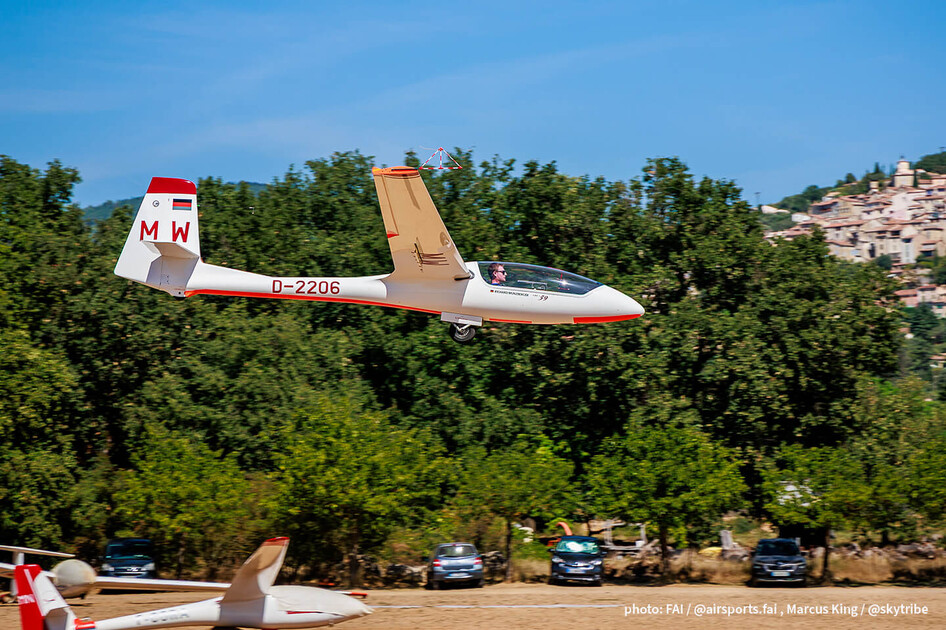
Nick Weiss in the SZD-59 against a backdrop of southern France
Was there a World Championship program in which the SZD-59 pilots were able to capitalize on their advantage?
Nick Weiss:
“In the sixth program, the first maneuver we had to fly was a 90-degree turn with a 60-degree bank angle. This maneuver is easier when I’m flying at a higher speed. Maneuver two, however, started with a spin. That means I have to slow down significantly between maneuvers one and two. This requires a lot of distance, which in turn isn’t good for a high position score.
That’s why pilots usually use the air brakes here to get rid of the excess energy. But that costs me altitude. The Foxes, in particular, have trouble with this. Since I don’t have that problem with the SZD, I can be a little less conservative here and focus instead on better positioning.”

Program 6 of the 8th competition day, in the cockpit of a competing pilot.
Program 6 is one of the “unknown” programs. This category also includes Program 2, Program 4, and Program 5. How are the “unknown” programs determined?
Nick Weiss:
“Each nation selects individual maneuvers. In the end, there are seven maneuvers, which each national team must then combine into a proposed program. The jury then decides which proposed program must be flown.”
You have three pilots on the national team who competed in the Advanced class with an Acro. Did you want to—and were you able to—present a flight program to the jury that highlighted the flight characteristics of the SZD-59 for your pilots?
Nick Weiss:
“In Program 6, the jury chose our proposed program. That’s exactly the program I described above with the turn and the spin.”
Was your strategy successful?
Nick Weiss:
“I took the day’s victory in both Program 2 and 4 and finished in 4th place in Program 6. Richard delivered strong performances, placing third in Programs 4 and 6 and second in Program 5.”

Team Leader Franziska Kaiser and Nick Weiss on the final day of competition before the last flight
Thank you very much, Nick, for showing us what goes on behind the scenes at a World Gliding Aerobatic Championship. We have one more request. Could you explain to those of us who are interested in aerobatics and are following the competitions, how and when the judges award an “HZ” when scoring individual maneuvers?
Nick Weiss:
“If a pilot makes a major mistake (e.g., a roll is not flown technically correctly), the judge can award a Hard Zero. If the majority of the judges agree, the chief judge issues a ‘Confirmed Hard Zero.’ This means that any scores already assigned by the judges are adjusted to a score of 0. In other words, this penalty is extremely costly. When exactly a judge awards an HZ varies greatly. But here’s an example:
We had to fly a roll in four segments. This means the roll should be divided into four equal segments. You start in normal flight, stop in a knife-edge position, transition into inverted flight, stop again in a knife-edge position, and finally return to a normal flight.
Since, as is well known, an airplane doesn’t fly particularly well in a knife-edge position, pilots tend to make this stop very brief. This can result in the judges being unable to recognize the stop under certain circumstances. In that case, the maneuver would be considered incorrectly flown, and they would award me an HZ."
By the way, that's exactly what happened to me in Program 5. Three of the judges didn't notice the stop. Luckily, the rest did, so the HZ was canceled and I didn't lose any points."

Touch Down at the 6st competion day
If you'd like to learn a little more about the German national team during the World Gliding Aerobatic Championships, you can read the daily reports here:

The proud German national team after the award ceremony.

Udane lato dla SZD-59 ACRO
01.11.2022